Notes on Reading

  • Afternoons & Coffeespoons

    A Division of Read & Bookmarked spotlighting poetry books that I’ve read or want to read.

    PS: These are my FeeEEElllings and are not necessarily critiques.

    PPS: I’m reading poetry all month for the Sealy Challenge.

    PPPS: Thank you to the publishers listed for the books that were so kindly gifted in exchange for an honest review.

    Soundtrack by Michael V. Smith

    Exerpt from Bookhug Press Website: With his signature humour and tenderness, and guided by the music of the era, Smith catalogues social prejudices, court rulings, and medical breakthroughs, alongside personal devastations, triumphs, and the search for community. From a first crush toting a Michael Jackson Thriller cassette, to falling in love to the music of Jane Siberry, to dancing at a gay bar to “Groove Is in the Heart,” Soundtrack is a moving personal record of a man who survived the lost generation and a vital document of queer joy.

    This book was gifted to me by Bookhug Press.

    I started reading this back in ’25. It’s divided into two parts, Side A (That I read in September ’25) and Side B (that I finished beginning of August ’26), which I thought was pretty clever.

    The author is very good at those ‘cut with a knife’ moments that really make you feel like your heart is being cut or burned with emotion. It’s a lyrical memoir and you can tell its highly personal. It goes into details about his time during the AIDS crisis with heartbreaking lines but there is a line of joy that does not dissipate and leaves one hopeful by the last ‘track’. The hidden track at the back of the book was also another clever detail, with the font color in a light grey as opposed to a dark black, giving the aura of this poem a ghostly feel while reading.

    Standout Poems:

    • Kiss Me, Kiss Me, Kiss Me
    • Love’s Gonna Get Ya
    • The Lion & The Cobra
    • (Hidden Track: 26/09/24)

    I Used to Be a Pisces by Camilla Gibb

    Excerpt from Bookhug Press Website: I Used to Be a Pisces is a deeply felt meditation on love and belonging, exploring changing landscapes, loves, and selves. In these poems, accompanied by her original collage work, Gibb generously invites us to engage with our surroundings, recognize the relationships that shape our existence, and examine our longing for restoration and regeneration.

    This book was gifted to me from Bookhug Press.

    I didn’t connect with every poem in this this collection but I thought ‘Organ Meat‘ was pretty exceptional. It’s about (what I perceived as it being) a complicated mother and daughter relationships. Highly recommend checking that poem out and I did have the collages were fire. Here for the art. The collages inside the book are made by the writer and they have great composition and feeling.

    Standout Poems:

    • Organ Meat

    This Wound is a World by Billy-Ray Belcourt

    Exerpt from Penguin Canada Website: Part manifesto, part memoir, This Wound is a World is an invitation to “cut a hole in the sky to world inside.” Billy-Ray Belcourt issues a call to turn to love and sex to understand how Indigenous peoples shoulder sadness and pain like theirs without giving up on the future. His poems upset genre and play with form, scavenging for a decolonial kind of heaven where “everyone is at least a little gay.”

    This book was gifted to me by McCelland & Stewart and is a part of the Kanata Classics Collection.

    Billy-Ray Belcourt is the kind of poet that makes you realize you’ve stopped breathing mid sentence because of how well his words fix your brain to focus on the words and the words only. He really know how to evoke feeling in his reader, especially this one. The book was a joy and heartbreak to read. There are so many standout poems, but I’m just going to list the ones that really hit home. I am buying the rest of his books with my hard earned cash.

    Standout Poems:

    • The Cree Word for a Body Like Mine is Weesageechak (the last two lines in the second paragraph snapped a few arteries in my heart)
    • Love and Heartbreak are Fuckbuddies
    • The Backalley of the World
    • Love is a Moontime Teaching
  • The Bro Notes

    The Bro Notes, Reading The Brothers Karamazov: The Bro-ening, A Woman’s Journey is a year long journey to complete this classic novel by Fyodor Dostoevsky.

    The Brothers Karamazov by Fyodor Dostoevsky was an amazing reading experience. IT falls under the category of books that I love the best, weird with moments that provoke eyebrow lifting, laughing out loud, and blood rushing to my head after reading sentences so well put together that I kind of die a little inside.

    Sigmund Freud was right about this and only this (His quote “The most magnificent novel ever written.” is the only review on the back of the Penguin Classic edition).

    This has become third on my list of the best books that I’ve ever read, falling hairs short after Carpentaria and Praiseworthy by Alexis Wright (who again, again, and every chance I get to say this, are books that everyone must read).

    I didn’t go into this book to learn anything, but to be entertained. Entertained I was. These characters were the drama. Mitya might ask ‘Am I the drama?’ with a vacant and unaware stare, but after reading you would want to stare back with a vacant and fiercely intent stare.

    A part of me always thinks a little poorly on myself for not trying to dissect some intelligent and thought provoking commentary but it was not as if the point didn’t get across. The lessons glide into your head without much effort. If I didn’t fully grasp a chapter, I would listen to it. If I still didn’t get it, I would read it again. I think if you’re weary of feeling like an idiot reading it (like I did), put those reservations away. Dostovesky’s got you.

    The book is chunky, but I both read and listened to the audiobook (narrated by Luke Thompson, who is an ACTOR in the way he brings flavor to every single character that makes you think there’s more than one narrator) and I separated the pages with tabs to make mileage markers, so to speak. These small details helped me from becoming overwhelmed.

    What also helps is that the text is highly readable. It’s funny. It’s thoughtful. Dostovesky makes you both hate and love his characters with just a couple of well placed words. My copy is cracked (broken spines are my personal bane), but I like seeing the dents and flipped corners of the pages. There are a dozens of tabs marking my favorite sentences.

    There is an outright joy in finishing something that I didn’t think I would finish and didn’t think I would understand.

  • The Bro Notes

    The Bro Notes, Reading The Brothers Karamazov: The Bro-ening, A Woman’s Journey is a year long journey to complete this classic novel by Fyodor Dostoevsky.

    Part 2 of 4: Good Bros/Bad Bros

    I’m really digging the bros.

    But do I dig Smerdyakov (who is technically a half-bro Karamazov)?

    No.

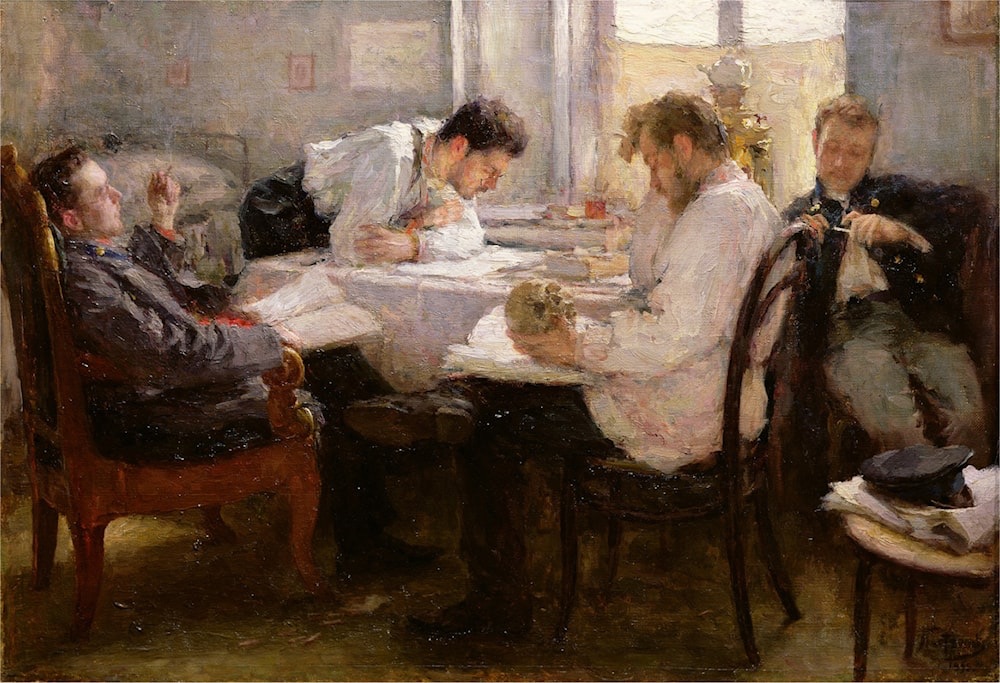
    This dislike is further reinforced by the publisher’s decision to crop the artwork ‘Detail from The Day Before the Exam (1895)’ by Leonid Ossipovitch Pastemak which originally depicts four men, and not three. Yes, Penguin. Cut that snake out.

    None of the brothers are infallible but I’m getting that this is one of the many gists of Dostoyevsky’s book. Nobody is entirely good. Even some monks that Alyosha lives with are a little bit of a dick sometimes. One whole chapter is dedicated to the stench of a dead monk and how some of his brothers believe that this means he wasn’t as holier than thou (He never was, I think that was just his rep).

    Alyosha is naive, but that inherently doesn’t make him good. Ivan is cold as ice but but he’s like more like glass.

    Concerning Dimitri, Alyosha says it best.

    “You’re not a wicked man, but a corrupted one,’ Alyosha smiled.

    But Smerdyakov? Naw. Non. Nyet.

    He’s just laying it all out there in the chapter with Ivan. This evil (subject to perception) bro’s plot is going to happen. But the chapter entitled “It’s Always Interesting to Talk to a Clever Man’ is so good. It’s very good, especially after ‘The Grand Inquisitor’, when Ivan’s just popping off on Alyosha. To see Ivan shatter a little under Smyrdakov’s blatant remarks is a little satisfying.

    I think this drives home the point home somewhat as not even the reader is infallible.

    I’m fixated a little on Smerdyakov because of this quote, also in part, a quote used for the title chapter:

    “So it’s true what they say, then: that it’s always interesting to talk to a clever man,” Smerdyakov answered resolutely, giving Ivan Fyodorovich a heartfelt glance.

    Heartfelt my ass.

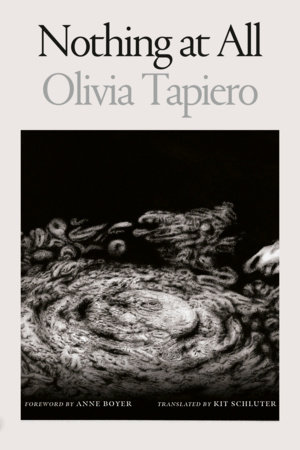
  • Nothing at All by Olivia Tapiero, translated by Kit Schluter

    “It wasn’t a hatred of the other but a shame of oneself, and there’s nothing more dangerous than people who choke down their wounds.”

    Excerpt rom Penguin Website: “An atmospheric rumination on gendered violence, cosmic collapse, and colonialism, from acclaimed author Olivia Tapiero, finalist for the Governor General’s Literary Award, the Lambda Literary Awards, and the Grand Prix du livre de Montréal. Available for the first time in English, with an all-new foreword by Anne Boyer.”

    I’m a fan of the Strange Light books in general (they publish one of my favorite authors, Eugene Martin), so I tend to trust the books they publish or at least give them a chance.

    Happy to report that my trust remains intact.

    The author is really good at blending a feeling of starkness with luscious and smart wording that doesn’t cushion the reading experience. That little extra grime and/or edge, depending on the context rounds out the book quite well. Words like ‘fuckable fool’ or sentences like “I desired you to the point of contempt, cherished your flippancy to the point of eating the moldy compost that enables it.” were just real pleasures to read.

    The fragments of paragraphs made me feel like like I too was going to collapse in some black hole, with a cloying feeling that made me think I should start crawling to get out of the dark.

    The cover design, with art by the translator, is really beautiful and reflects the book tone perfectly. I also appreciate (love, very much love) a black page to divide chapters. I think it’s a great design choice, especially with the quotes that appear behind the chapter title pages with the same black paper/white font combo.

    The book published March 17, 2026 and I hope it gets as much traction as it can.

  • The Bro Notes

    The Bro Notes, Reading The Brothers Karamazov: The Bro-ening, A Woman’s Journey is a year long journey to complete this classic novel by Fyodor Dostoevsky.

    Part 1 of 4: A Quarter Complete.

    I started reading (listening, which is also reading) The Brothers Karamazov by Fyodor Dostoevsky to be impressive. To feel ‘lit bro’.

    Am I little impressed that I made it a quarter of the way through the book? Maybe. Since finishing reading the giant books of Alexis Wright (Carpentaria and Praiseworthy, each over 800 pages), I felt a surge of blind confidence that I could conquer anything. That certainly is ‘bro’.

    The Brothers Karamazov has over 390K ratings and 25K reviews on Goodreads. There are countless webpages and blogs dissecting the book in ways I can’t quite wrap my head around. There are dozens of Reddit posts inferring that they are better people, or that they are better than other people for having read it. When I saw the book’s readership trend on Instagram, I fell like a domino. How ‘bro’ of me to be so trendy.

    I prepared notebooks and character notes. The notebooks remain blank and the printed out character guides quickly became useless. This only reinforced that I am unreliable when it comes to making notes and gathering my thoughts. The task of reading this book almost became insurmountable until I reached Part 1, Book 2, Chapter 8, where after speaking with clergymen about his son Dimitri to condemn him and then relaying his own bad behavior, the father Fyodor (who shares the same name as the author) is about to leave in his carriage and basically thinks ‘fuck it, I’m an agent of chaos’, marches back inside, and goes off on all of his haters (and proceeds to remove his youngest son, Alyosha from the monastery).

    This is where the ‘yes’ feeling settled in. I have become highly entertained by this book and am delighted that this quickly became my reason to continue. Its entertainment value has to be the reason for the book’s longevity. I refuse to acknowledge any other reason. Good versus evil? Deep lessons on philosophy, morality, and theology? Ha. I refuse to take any lessons from this book except how to identify red flags in the human condition.

    Fyodor is a dick. Dimitri is a dick. Ivan is a true middle child and Alyosha is either a messenger for chaos or a true youngest child (two things can be true at the same time). And Smerdyakov? We don’t speak about Smerdyakov in this house. Every character in this book is layered and complex below what reads sometimes like a simple exterior.

    I saw a meme of a 1 star review somewhere describing Pride and Prejudice as ‘just a bunch of people going over to each other’s houses’ (hilarious). At this point in the book, yes, technically, it’s happening, and yes, technically, Alyosha is the one moving from house to house being a messenger/chaos witness to chaos people. Even if there were no meaning behind Dostoyevsky’s words, I’d still give this book (so far) at least 4 stars for the soapy nature of these interactions, if I did rank books at all.

    I abso-fucking-lutely love this book and I hope to continue to love it. I would just like to mention that listening to the book, in combination with reading the book, has really enriched my experience. Luke Thompson (actor on Bridgerton) does the narration. He is an amazing audio narrator. Truly gifted. Every voice is distinct. He brings up just the right emotion and inflection to his voice. Any bump in my reading was juxtapose with listening to a chapter. It really gave me a clearer sense of the text and helped with my retention of the plot and characters.

    Here are some of my random thoughts and favorite scenes at the 25% mark:

    • Alyosha is a deer. Are there headlights in the 1800’s? Every time he ends up in the middle of the chaos I want to yell at him to get off the road. He gets bit, he gets yelled at, but he just sort of sits and comments politely (or heatedly enough for him).
    • Katarina and Grushenka’s interaction in front of Alyosha was gold standard. It was a great introduction to Grushenka which sort of subverted my image of her which until then was more dictated by Fyodor and Dimitri.
    • Dimitri’s drunken rant to Alyosha.
    • Fyodor’s drunken rant to Alyosha.
    • The ‘How I Met Your Mothers’ chapters. Fyodor is terrible. He is terrible.
    • The dinner in the monastery scene. “They all thought I’d left, but here I am!” He shouted to the whole chamber.” (Book 2, Chapter 8, Page 117) I nearly busted a gut laughing.

    I have until January 1, 2027 to read this book, a goal I may or may not reach but considering how rich this book reads, I’m hoping I stick to it.