Tag: fiction

  • The Bro Notes

    The Bro Notes, Reading The Brothers Karamazov: The Bro-ening, A Woman’s Journey is a year long journey to complete this classic novel by Fyodor Dostoevsky.
    Part 2 of 4: Good Bros/Bad Bros

    I’m really digging the bros.

    But do I dig Smerdyakov (who is technically a half-bro Karamazov)?

    No.

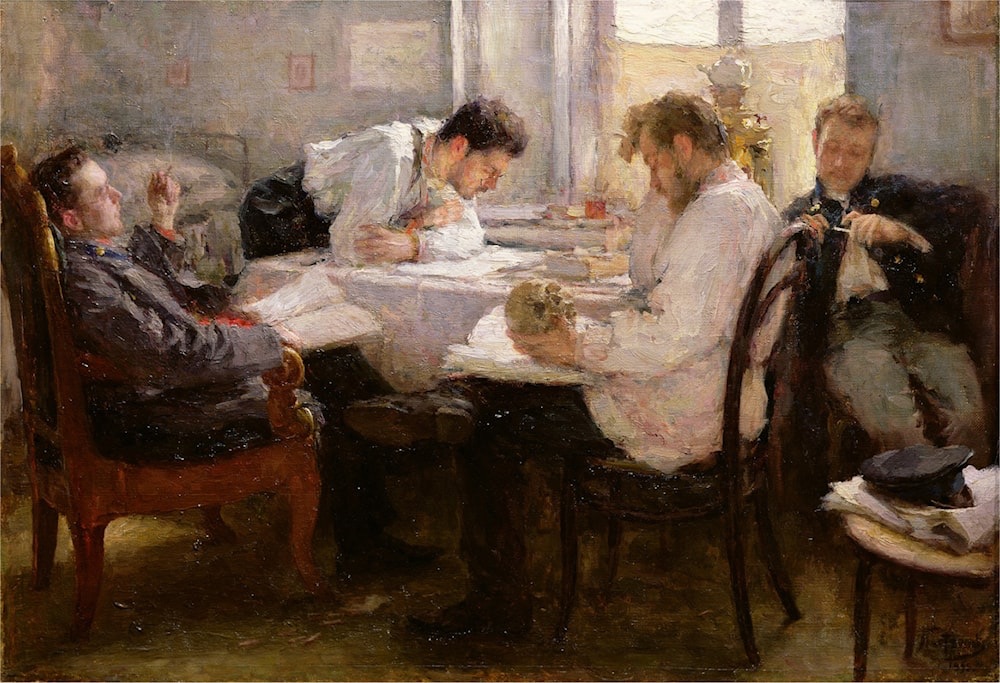
    This dislike is further reinforced by the publisher’s decision to crop the artwork ‘Detail from The Day Before the Exam (1895)’ by Leonid Ossipovitch Pastemak which originally depicts four men, and not three. Yes, Penguin. Cut that snake out.

    None of the brothers are infallible but I’m getting that this is one of the many gists of Dostoyevsky’s book. Nobody is entirely good. Even some monks that Alyosha lives with are a little bit of a dick sometimes. One whole chapter is dedicated to the stench of a dead monk and how some of his brothers believe that this means he wasn’t as holier than thou (He never was, I think that was just his rep).

    Alyosha is naive, but that inherently doesn’t make him good. Ivan is cold as ice but but he’s like more like glass.

    Concerning Dimitri, Alyosha says it best.

    “You’re not a wicked man, but a corrupted one,’ Alyosha smiled.

    But Smerdyakov? Naw. Non. Nyet.

    He’s just laying it all out there in the chapter with Ivan. This evil (subject to perception) bro’s plot is going to happen. But the chapter entitled “It’s Always Interesting to Talk to a Clever Man’ is so good. It’s very good, especially after ‘The Grand Inquisitor’, when Ivan’s just popping off on Alyosha. To see Ivan shatter a little under Smyrdakov’s blatant remarks is a little satisfying.

    I think this drives home the point home somewhat as not even the reader is infallible.

    I’m fixated a little on Smerdyakov because of this quote, also in part, a quote used for the title chapter:

    “So it’s true what they say, then: that it’s always interesting to talk to a clever man,” Smerdyakov answered resolutely, giving Ivan Fyodorovich a heartfelt glance.

    Heartfelt my ass.

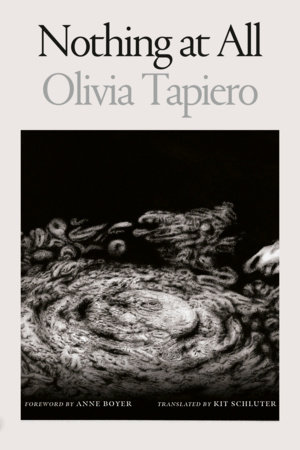
  • Nothing at All by Olivia Tapiero, translated by Kit Schluter

    “It wasn’t a hatred of the other but a shame of oneself, and there’s nothing more dangerous than people who choke down their wounds.”

    Excerpt rom Penguin Website: “An atmospheric rumination on gendered violence, cosmic collapse, and colonialism, from acclaimed author Olivia Tapiero, finalist for the Governor General’s Literary Award, the Lambda Literary Awards, and the Grand Prix du livre de Montréal. Available for the first time in English, with an all-new foreword by Anne Boyer.”

    I’m a fan of the Strange Light books in general (they publish one of my favorite authors, Eugene Martin), so I tend to trust the books they publish or at least give them a chance.

    Happy to report that my trust remains intact.

    The author is really good at blending a feeling of starkness with luscious and smart wording that doesn’t cushion the reading experience. That little extra grime and/or edge, depending on the context rounds out the book quite well. Words like ‘fuckable fool’ or sentences like “I desired you to the point of contempt, cherished your flippancy to the point of eating the moldy compost that enables it.” were just real pleasures to read.

    The fragments of paragraphs made me feel like like I too was going to collapse in some black hole, with a cloying feeling that made me think I should start crawling to get out of the dark.

    The cover design, with art by the translator, is really beautiful and reflects the book tone perfectly. I also appreciate (love, very much love) a black page to divide chapters. I think it’s a great design choice, especially with the quotes that appear behind the chapter title pages with the same black paper/white font combo.

    The book published March 17, 2026 and I hope it gets as much traction as it can.

  • The Bro Notes

    The Bro Notes, Reading The Brothers Karamazov: The Bro-ening, A Woman’s Journey is a year long journey to complete this classic novel by Fyodor Dostoevsky.

    Part 1 of 4: A Quarter Complete.

    I started reading (listening, which is also reading) The Brothers Karamazov by Fyodor Dostoevsky to be impressive. To feel ‘lit bro’.

    Am I little impressed that I made it a quarter of the way through the book? Maybe. Since finishing reading the giant books of Alexis Wright (Carpentaria and Praiseworthy, each over 800 pages), I felt a surge of blind confidence that I could conquer anything. That certainly is ‘bro’.

    The Brothers Karamazov has over 390K ratings and 25K reviews on Goodreads. There are countless webpages and blogs dissecting the book in ways I can’t quite wrap my head around. There are dozens of Reddit posts inferring that they are better people, or that they are better than other people for having read it. When I saw the book’s readership trend on Instagram, I fell like a domino. How ‘bro’ of me to be so trendy.

    I prepared notebooks and character notes. The notebooks remain blank and the printed out character guides quickly became useless. This only reinforced that I am unreliable when it comes to making notes and gathering my thoughts. The task of reading this book almost became insurmountable until I reached Part 1, Book 2, Chapter 8, where after speaking with clergymen about his son Dimitri to condemn him and then relaying his own bad behavior, the father Fyodor (who shares the same name as the author) is about to leave in his carriage and basically thinks ‘fuck it, I’m an agent of chaos’, marches back inside, and goes off on all of his haters (and proceeds to remove his youngest son, Alyosha from the monastery).

    This is where the ‘yes’ feeling settled in. I have become highly entertained by this book and am delighted that this quickly became my reason to continue. Its entertainment value has to be the reason for the book’s longevity. I refuse to acknowledge any other reason. Good versus evil? Deep lessons on philosophy, morality, and theology? Ha. I refuse to take any lessons from this book except how to identify red flags in the human condition.

    Fyodor is a dick. Dimitri is a dick. Ivan is a true middle child and Alyosha is either a messenger for chaos or a true youngest child (two things can be true at the same time). And Smerdyakov? We don’t speak about Smerdyakov in this house. Every character in this book is layered and complex below what reads sometimes like a simple exterior.

    I saw a meme of a 1 star review somewhere describing Pride and Prejudice as ‘just a bunch of people going over to each other’s houses’ (hilarious). At this point in the book, yes, technically, it’s happening, and yes, technically, Alyosha is the one moving from house to house being a messenger/chaos witness to chaos people. Even if there were no meaning behind Dostoyevsky’s words, I’d still give this book (so far) at least 4 stars for the soapy nature of these interactions, if I did rank books at all.

    I abso-fucking-lutely love this book and I hope to continue to love it. I would just like to mention that listening to the book, in combination with reading the book, has really enriched my experience. Luke Thompson (actor on Bridgerton) does the narration. He is an amazing audio narrator. Truly gifted. Every voice is distinct. He brings up just the right emotion and inflection to his voice. Any bump in my reading was juxtapose with listening to a chapter. It really gave me a clearer sense of the text and helped with my retention of the plot and characters.

    Here are some of my random thoughts and favorite scenes at the 25% mark:

    • Alyosha is a deer. Are there headlights in the 1800’s? Every time he ends up in the middle of the chaos I want to yell at him to get off the road. He gets bit, he gets yelled at, but he just sort of sits and comments politely (or heatedly enough for him).
    • Katarina and Grushenka’s interaction in front of Alyosha was gold standard. It was a great introduction to Grushenka which sort of subverted my image of her which until then was more dictated by Fyodor and Dimitri.
    • Dimitri’s drunken rant to Alyosha.
    • Fyodor’s drunken rant to Alyosha.
    • The ‘How I Met Your Mothers’ chapters. Fyodor is terrible. He is terrible.
    • The dinner in the monastery scene. “They all thought I’d left, but here I am!” He shouted to the whole chamber.” (Book 2, Chapter 8, Page 117) I nearly busted a gut laughing.

    I have until January 1, 2027 to read this book, a goal I may or may not reach but considering how rich this book reads, I’m hoping I stick to it.